Roots Music Canada’s Essential Canadian Albums series tells the stories of the recordings that every Canadian music fan should have in their collection.
Gordon Lightfoot made his formal debut at the start of 1966 with Lightfoot!, an album that seemed the final destination on the twisted path he’d been on for the previous few years, from square dancing on CBC television variety shows to making several singles in Nashville that found him following in the footsteps of Pat Boone.
But after a recommendation from his friend Ian Tyson, Lightfoot found himself on the radar of Bob Dylan’s manager Albert Grossman, after which his original songs were suddenly in demand by artists including Peter, Paul & Mary, Marty Robbins and even pre-Velvet Underground Nico. Lightfoot performed at the Newport Folk Festival in 1965 during the afternoon preceding Dylan’s evening “electric” set—Johnny Cash, in fact, didn’t, but having an actor portray Lightfoot in A Complete Unknown wouldn’t have been as exciting—and by year’s end Grossman had found him a deal with United Artists.
Lightfoot! was an impressive showcase of his talents, containing his best material to that point: “Early Morning Rain,” “For Lovin’ Me,” “Steel Rail Blues,” and “I’m Not Sayin’” among others, but with the sessions having taken place over a year earlier in December 1964, the performances came off as quaint and out of step with popular music’s rapid evolution during the mid-Sixties.
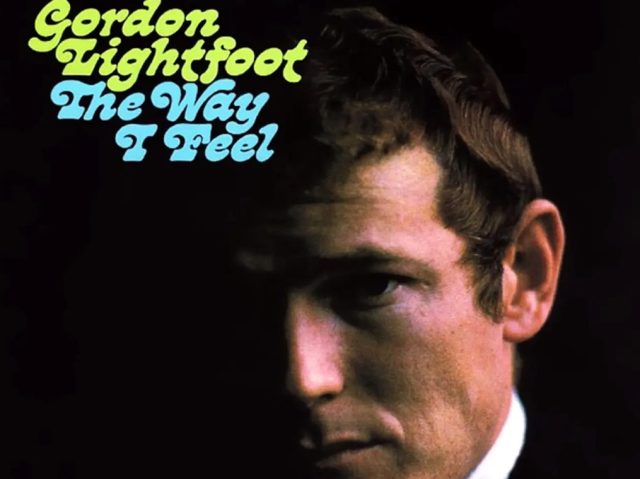
Catching up to those changes seemed to be a motivating factor when it came time to make The Way I Feel in early 1967. Rather than recording Lightfoot again in New York, producer John Court brought him and his trusted sidemen, guitarist Red Shea and bassist John Stockfish, to Nashville where they were augmented by multi-instrumentalist Charley McCoy and drummer Kenny Buttrey, both of whom had made significant contributions to Dylan’s Blonde On Blonde the previous year.
Nothing illustrated the difference in approach more than the new take of “The Way I Feel,” which had also appeared on Lightfoot! Although it can’t necessarily be described as “psychedelic,” the use of heavy echo and other atmospheric touches, combined with Buttrey’s trademark groove that would appear again a few years later on Neil Young’s Harvest, produces heady results, and seems a prelude to the sound that would be adopted by new British folk-rock groups such as Fairport Convention.
But as an album, The Way I Feel overall captures the feeling of a young country just beginning to understand its origins, while embracing its potential. Of course, that’s captured—literally—on “Canadian Railroad Trilogy,” which CBC had commissioned Lightfoot to write to mark the centennial, but on other songs such as “Go-Go Round” and “Home From The Forest,” the past and present subtly intertwine to illustrate the reality of Canada’s growing urban centres, in many ways for the first time.
“Go-Go Round” tells the story of a girl, “only 21, just in from somewhere,” forced to earn a living by dancing in nightclubs. She falls for a traveling musician who ultimately leaves her to fend for herself in the big city. “Home From The Forest” offers a similar story, but from an entirely different perspective. In it, an old man from an unnamed rural location finds his road at an end in a city where he spends his days wandering the streets, and his nights drinking in a dingy room. The song culminates with the man having a heart breaking flashback of his pastoral youth, just before he dies alone.
Along with these slices of life that complemented the work of new generation Nashville songwriters such as Kris Kristofferson, The Way I Feel also contains one of Lightfoot’s perennial favourites, “Song For a Winter’s Night,” which has become a touchstone for a vast number of Canadians seeking a shred of romance in order to get through the coldest and darkest months.
Like its predecessor, The Way I Feel only sold a modest 20,000 copies, prompting different producers to tinker with Lightfoot’s sound on subsequent albums, until a move to Reprise Records (home to Neil Young and Joni Mitchell) in 1970 finally saw him break through with “If You Could Read My Mind.” Lightfoot would go on to build his impressive Reprise catalogue over the ensuing decade, and even re-record his best United Artists material on the massive selling Gord’s Gold compilations.
But the most magical moments on those early albums could never be replicated, and The Way I Feel stands as the pivotal moment when Lightfoot found his voice, and ultimately, became a voice for Canadians coast to coast.